
Buying wholesale fabric used to mean trade shows, industry contacts, and a lot of cold calls. Now you can source an entire season’s worth of material from your studio, your kitchen table, or wherever you do your best work. The internet has made wholesale fabric more accessible than ever, and that’s a good thing for designers and brands at every scale.
That said, online fabric sourcing comes with its own set of challenges. You can’t feel the weight of a crepe between your fingers from a product page. Colors look different on a monitor than they do under studio lighting. And minimum order quantities, shipping timelines, and supplier reliability aren’t always spelled out clearly upfront.
So let’s walk through the whole process, from figuring out what you need to placing your first order with confidence.
What buying wholesale fabric actually means
Before anything else, it helps to get clear on what you’re actually buying into. Wholesale fabric means purchasing material directly from a manufacturer or distributor at a lower per-yard cost than retail, typically by meeting a minimum order quantity. You’re buying as a business, not as an individual consumer, and the pricing reflects that.
For example, a ponte knit that retails for $10 to $14 per yard might run $4 to $7 at wholesale. Across a full production run, that spread matters enormously to your margins.
Difference Between Wholesale and Retail
Retail fabric stores, whether physical or online, are set up for individual buyers. Low or no minimums, higher per-yard pricing, and a selection built around home sewing projects. This model works for a one-off project. But when you’re planning a production line, you need wholesale pricing. Wholesale suppliers, on the other hand, serve apparel brands, garment manufacturers, costume and dancewear producers, and commercial buyers who need material at volume pricing. This makes it easy to:
- Source larger quantities
- Maintain consistent materials across production runs
- Keep fabric costs under control as order volumes increase.
Read more: Buying wholesale fabric vs buying retail fabric.
Know what you need before you start browsing
Browsing a fabric catalog without a clear brief is like grocery shopping without a list. You’ll come home with things you love but can’t actually use.
Before you search, write down:
- Fiber content. Cotton? Polyester? Rayon? A performance blend? The fiber content drives drape, care requirements, and price.
- Construction. Woven or knit? Structured or drapeable? Does the silhouette require stretch?
- Weight. GSM (grams per square meter) is the standard measure. A lightweight chiffon sits around 30 to 60 GSM. A mid-weight ponte knit runs 200 to 280 GSM. Knowing your target weight keeps you from falling for a fabric that’s too sheer or too stiff for your design.
- Yardage estimate. How many yards per style, per colorway? Multiply that across your production run, and you’ll know whether a 10-yard minimum or a 50-yard minimum works for your needs.
Getting your yardage estimate right
A solid yardage estimate accounts for more than just the pattern pieces. Add 5 to 10 percent for cutting waste, shrinkage (especially with natural fibers), and any adjustments from your toile stage. Running short mid-production because you ordered to the exact number is one of the most preventable problems in the sourcing process. Our fabric yardage guide walks through the math in detail if you want a closer look at how to calculate by garment type.
And if you’re new to calculating yardage, the general rule for apparel is to add at least one full pattern length to your estimate as a buffer. We’re always happy to help if you have questions about quantities before you order. Reach out to our team, and we’ll point you in the right direction.
How to find a wholesale fabric supplier online that you can trust
Not all wholesale suppliers are built the same. The right one ships accurately, communicates clearly, carries in-stock inventory, and stands behind what they sell. Here’s how to tell the difference.
1. Go for a supplier with in-stock inventory
Some suppliers list extensive catalogs but carry very little physical inventory. They’re ordering from a mill on your behalf, which means longer lead times, less control over dye lot consistency, and more risk of delays. In-stock inventory means the fabric is on the shelf and ready to ship. This is a plus when you’re working against a production deadline. At Zelouf, every fabric you see in our online store is available by the yard, in stock, and ready to ship. No waiting on a mill order or guessing on availability.
2. Be sure that the supplier’s minimum order quantities work for your scale
MOQs vary widely. Some suppliers require 50 yards per colorway. Others sell by the yard with no floor at all. Actually, neither is better. The right choice depends entirely on your production volume and how confident you are in a fabric before you commit.
If you’re testing a new fabric or running a smaller order, low or no minimums give you the flexibility to sample at production scale without overcommitting inventory. If you’re scaling up, a supplier with higher MOQs and competitive volume pricing might make more sense. The point is to match the supplier’s model to your actual needs, not the other way around.
3. Order a swatch program before the volume
A supplier who won’t let you touch the fabric before you buy is a red flag. Good wholesale fabric suppliers offer swatches, either complimentary or for a nominal charge, so you can evaluate the material in person before placing a production order.

We offer free swatches on request (just pay shipping). It’s the most reliable way to evaluate drape, hand feel, and color accuracy under your studio lighting before you commit to yardage.
The buying process, step by step
Once you’ve defined your brief and identified a supplier or two to test, here’s how the buying process should go.
1. Start with swatches, always
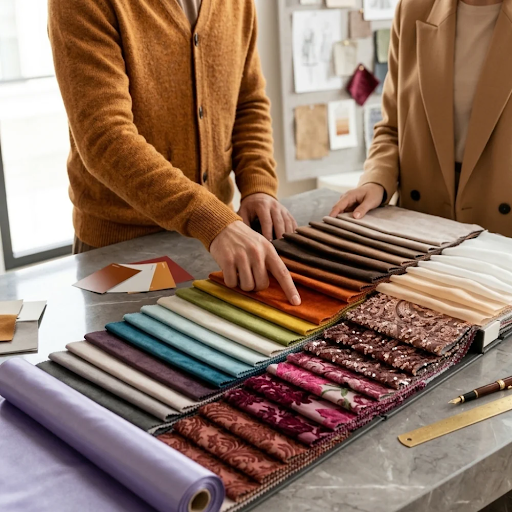
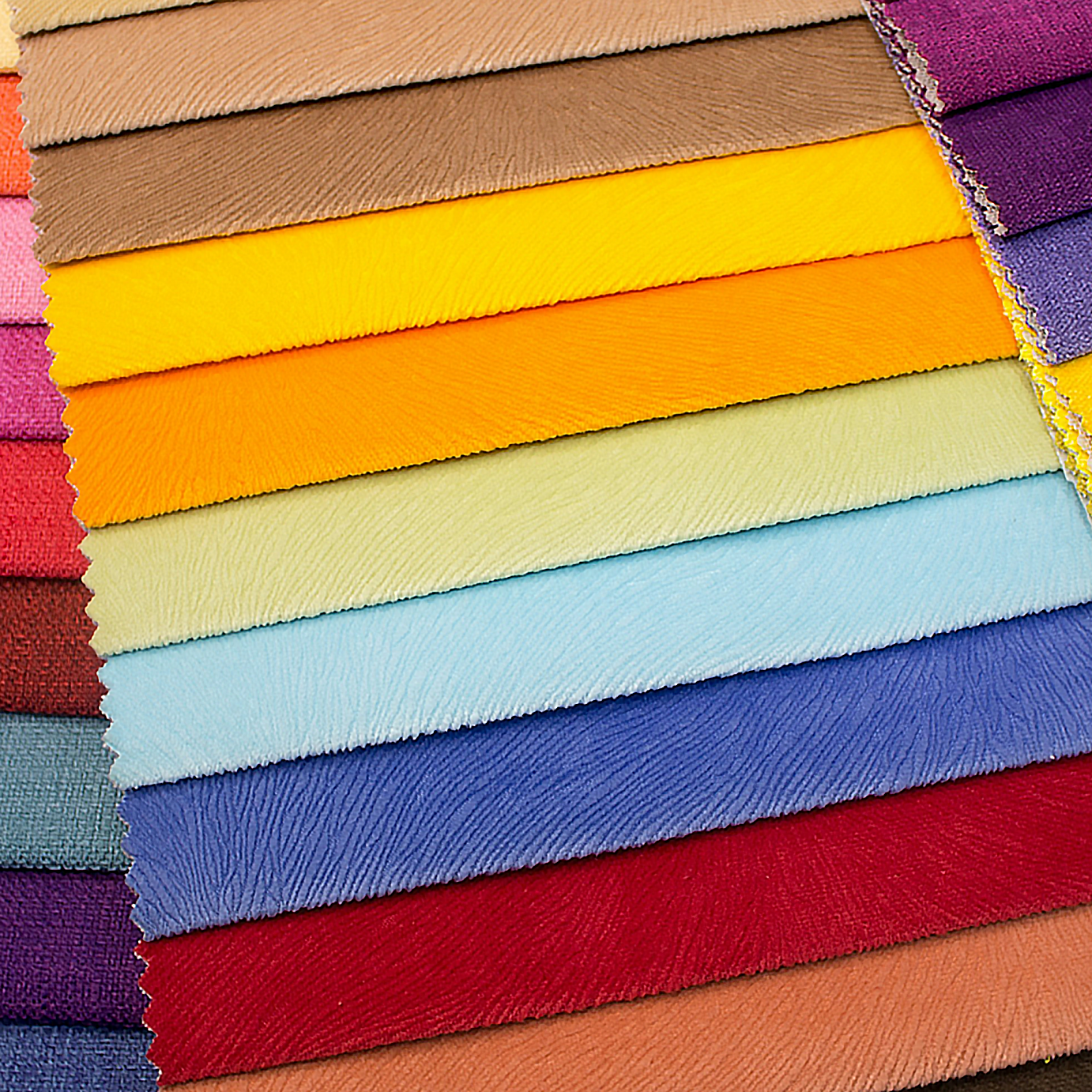
Order swatches before you order yardage. This is non-negotiable. A photograph tells you what a fabric looks like. A swatch tells you what it actually is: how it drapes off the roll, how it feels in your hand, and how the color reads under different light sources. Order swatches for every fabric you’re seriously considering, even if you’re fairly confident about the choice.
2. Test before you scale
After the swatch, place a small trial order before committing to your full production yardage. This tests the supplier’s fulfillment accuracy, consistency between the swatch and the bulk roll, and packaging quality. A supplier who performs well at the swatch and trial-order stage is one you can build a working relationship with.
3. Watch for dye lot consistency
Dye lot variations are a real issue in fabric production, especially with rich or saturated colors. Two rolls of the same fabric from different dye lots can look different in photographs and noticeably different in person. For any color-critical design, buy all the yardage you need from the same dye lot in one order rather than splitting it across multiple purchases.
Read more: How to buy fabric by the yard.
Checklist: What to look for in an online fabric catalog
A well-organized wholesale fabric catalog makes your sourcing process faster and more accurate. Here’s what a good one should offer.
- Clear product specifications. Every listing should include fiber content, GSM or weight descriptor, width, and care instructions. If a supplier’s listings are vague on these details, it’s a red flag.

- Multiple photos. One product image isn’t enough. Look for close-up texture shots, drape shots, and images taken under natural light, not just a flat lay under studio lighting.
- Accurate color representation. Even the best product photography can shift color slightly. A swatch program fixes this, which is why we always recommend ordering swatches for color-critical choices.
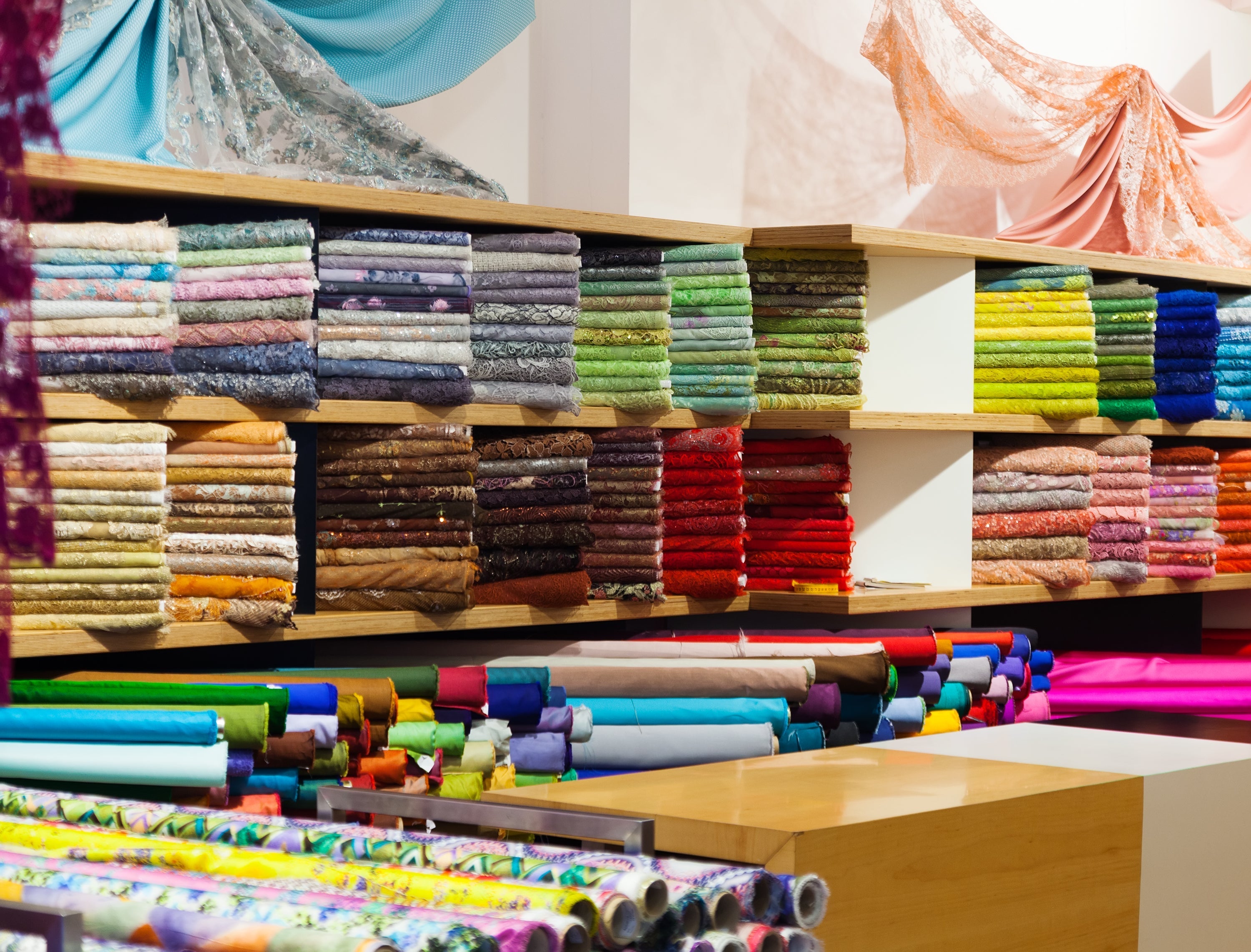
- Organized navigation. You should be able to filter by fabric type, fiber content, weight, or use case without clicking through dozens of irrelevant listings. Our store is organized by fabric type, color family, pattern, embellishment and project, so you can find what you need quickly. See how it looks:

- Availability transparency. You should always know whether a fabric is in stock, how much yardage is available, and whether it’s a permanent or seasonal offering. That information affects your planning.
Common questions to ask before you commit
Before placing any wholesale fabric order, it pays to get clear answers on a few things:
- What is the return or exchange policy? Things go wrong. Knowing how a supplier handles fulfillment errors before you’re in the middle of one saves a lot of stress.
- Is this fabric a permanent stock item or a seasonal offering? If you’re building a repeatable style around a specific fabric, you need to know whether you can reorder it six months from now.
- What’s the typical lead time from order to delivery? In-stock inventory should ship quickly. If a supplier quotes you a 6- to 8-week lead time on something listed as available, ask why.
- Can you verify fiber content documentation? For buyers who need compliance documentation for their retail accounts or export orders, this matters.
Ready to shop?
Buying wholesale fabric online doesn’t have to be complicated. Get clear on what you need, test before you scale, and build relationships with consistent, transparent suppliers.
Our online store at Zelouf Fabrics carries hundreds of in-stock wholesale fabrics available by the yard, from stretch velvet and ponte knit to mesh, satin, chiffon, and specialty prints. Browse by fabric type or color, and when you’ve found something worth exploring, request a FREE swatch (just pay shipping) so you can feel it before you commit.